Drifter mindset
I operate on the edge of established structures. Instead of polishing known routes, I design new navigation logics for complex systems.

Control Architecturedriven by Evidence Systems
xcec.solutions — Control Architecture
xcec is the architecture space where I design systems that can observe, evaluate, and steer themselves.
The content on this site describes operational logic, not narratives.
Complexity is not simplified here; it is made governable.
Operating Model
Signal → Assessment → Decision → Action → Feedback.
SIGNALCLARITY
Telemetry that triggers decisions instead of filling dashboards.
CONTROLRESILIENCE
Loops that surface drift early and counter-steer automatically.
EDGEAUTONOMY
Local intelligence that acts without waiting for central approval.
Foundation
I work where new patterns emerge: telemetry, drift, and governance form the baseline for every decision.
Input: Complexity, Constraints, Uncertainty, Drift, Governance
Output: Architectural boundaries, Decision logic, Control surfaces, Telemetry contracts, Evidence paths
I operate on the edge of established structures. Instead of polishing known routes, I design new navigation logics for complex systems.
Every deviation becomes visible, measurable, actionable. Drift is not hidden but treated as signal—technical, organizational, operational.
I start with signals, not tooling. Telemetry is the first design question and instantly links decisions to evidence.
Control behaves like a system BIOS: signal → assessment → decision → action → feedback. Governance wires policies, roles, and identities straight into the data streams.
Signal → hypothesis → decision: every key choice receives an evidence path.
Signal
Telemetry point, event, or deviation—clearly defined and measurable.
Hypothesis
What does the signal indicate? Which areas are affected? Which alternatives exist?
Decision
Deliberate choice with a documented evidence path anchored in governance.
Blueprint
I map systems by signals, decisions, and event chains—not org charts.
Organizations are mapped along signals, decisions, and causalities. System maps show where telemetry emerges and where control engages.
Core systems, processes, and infrastructures are modeled as digital twins before real-world change happens.
Toolchains follow event chains and evidence flows. Each system receives a defined place within the control stream.
Policies, identities, roles, and resilience mechanisms define intervention points—governance becomes active steering.
xcec acts as a composition layer orchestrating central and local intelligence and translating event chains into live operations.
Solutions
Input: Operational signals, System constraints, Objective trade-offs, Risk, Governance requirements
Output: Control loops, Executable policies, Operational artefacts, Risk observability, Decision boundaries
Signal routing into decisions.
Control loops wired to feedback.
Investor translation: Reduces decision latency and makes operational risk observable in real time.
Evidence paths attached to decisions.
Audit-ready reasoning encoded.
Investor translation: Improves accountability and reduces governance risk through traceable decision evidence.
Policies expressed as boundaries.
Runtime checks enforced at edges.
Investor translation: Stabilizes governance by enforcing decision boundaries and reducing uncontrolled operational drift.
Risk signals aggregated as state.
Deviations surfaced as control input.
Investor translation: Makes systemic risk measurable and reduces exposure by turning drift into governed control signals.
Projects
Live means: operated in production, with active telemetry, defined decision boundaries, and continuous control and feedback loops.
Input: Production operation, Active telemetry, Control boundaries, Governance context
Output: Live control surfaces, Audit trails, Feedback loops, Operational baselines
Hybrid production network
From regional producer to transparent, steerable value chain.
Telemetry across catch, processing, and throughput replaces gut feel as the basis for decisions.
City-wide identity framework
A city card becomes an instrument to steer visitor flows and utilisation.
Data is used to actively control campaigns, flows, and capacity—not for storage.
Energy autonomous district
An energy microsystem behaves like a living organism with clear loops.
Local intelligence, telemetry, and control loops boost autonomy and resilience.
Telemetry-first governance
R&D becomes an evidence system linking hypotheses, experiments, and decisions.
Time-to-learning replaces pure time-to-market; drift between vision and delivery stays visible.
Lesson learned: The decisive factor is the clarity of event chains and evidence paths—not another tool.
Operating model
Discovery, blueprint, control loop, transition—every engagement stays steerable.
Input: Prompts, Evidence, Judgment, Telemetry, Constraints
Output: Decisions, Runbooks, Feedback loops, System state, Accountability
Artefacts: digital twins, governance playbooks with loops, escalation paths and roles. Collaboration interfaces are co-designed with domain, IT, operations, and compliance.
The architectures described here emerge through a cooperative workflow between human responsibility and AI-assisted analysis.
I identify missing signals, drift points, and relevant system boundaries.
Telemetry and control-loop blueprints translate governance to the operational context.
I implement control loops in live operations: signals, decisions, automation, governance.
Handover with clear responsibilities, playbooks, and containerized services.
Visual systems
Graphics capture the principles: central intelligence, event chains, edge autonomy.
No placeholders. Each graphic documents a principle that keeps systems steerable across decades.
Philosophy · Central intelligence
Shows how central intelligence exchanges signals with edge nodes.

Core ↔ Edge
Signal weight
Latency bands
Philosophy · Systemic blueprint
Highlights where signals originate, intelligence sits, and control engages.

System maps
Telemetry points
Decision nodes
Philosophy · Evidence engine
Continuous path for control loops and evidence mechanics.
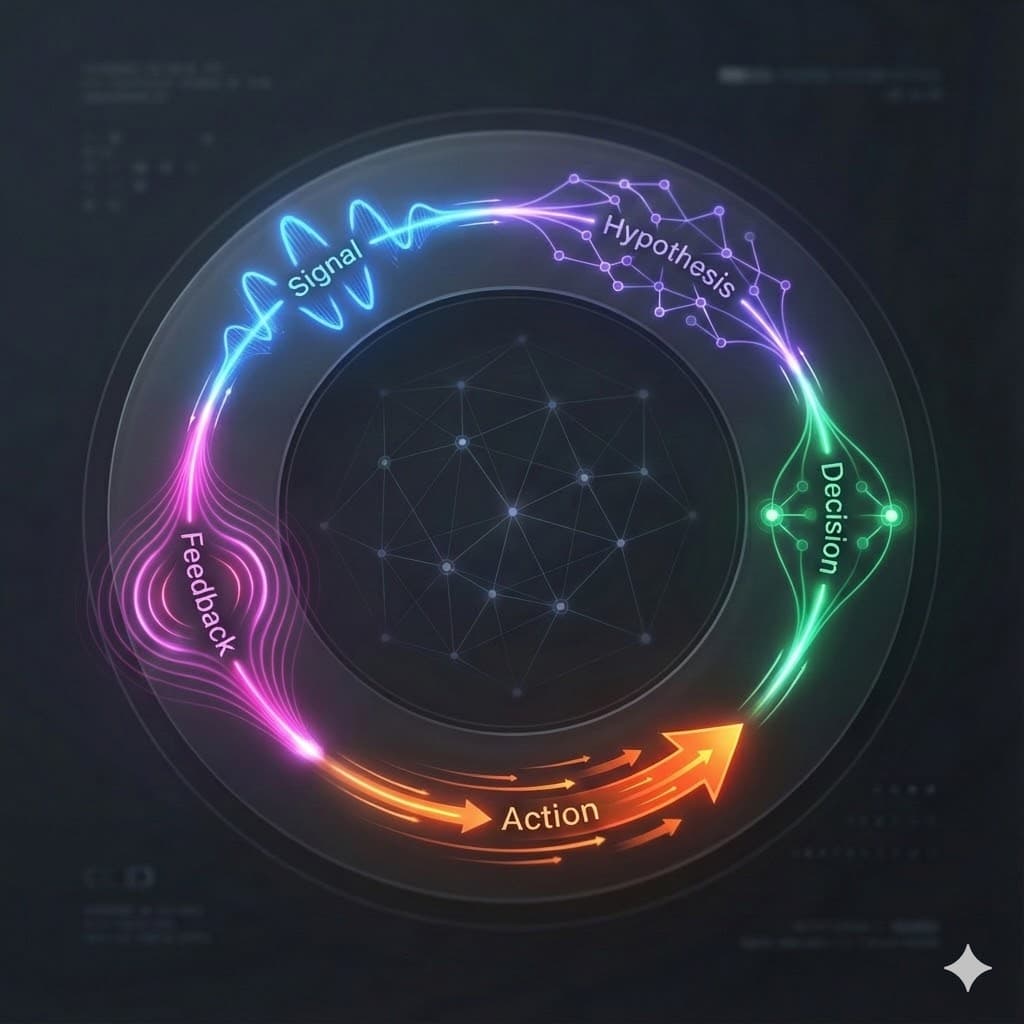
Signal
Hypothesis
Decision
Philosophy · Edge autonomy
Edge autonomy, local intelligence, and resilience visualized.

Autonomy index
Health zones
Fallback routes
Philosophy · Event chains
Timeline of a smart event chain from signal to action.

Signal
Decision
Action
Feedback
Philosophy · Policy systems
Policy routes that translate governance intent into executable control.

Policy graph
Runtime checks
Control depth
About
I design telemetry-first structures, digital twins, and governance architectures.
I operate where organization, technology, and governance must fuse—often in regulated, safety-critical, complex environments.
I think in systems, not projects. Exploration stays structured: I dive into system logic, build digital references, and translate outcomes into pragmatic control loops.
The drifter mindset is my compass: not bound to established routes, I read currents and use structure as navigation aid. Well-built structures create freedom rather than limit it.
I am responsible for the architecture, decision logic, and operational control of the systems described here.